 info@magnet-store.co.uk
 0800 009 6562


High Temperature and Heat Resistant Magnets
Every magnet loses some strength as it heats up, and above its maximum operating temperature part of that loss is permanent. The magnets in this range are made for hotter jobs, such as motors, sensors and machinery that runs warm: high temperature neodymium grades, samarium cobalt and ferrite. Each product page lists its maximum temperature. Choose from the stock sizes below. If you can’t see the grade or size you require, get in touch for a custom manufacturing quote.
High Temperature and Heat Resistant Magnets
High Temperature and Heat Resistant Magnets
Every magnet loses some strength as it heats up, and above its maximum operating temperature part of that loss is permanent. The magnets in this range are made for hotter jobs, such as motors, sensors and machinery that runs warm: high temperature neodymium grades, samarium cobalt and ferrite. Each product page lists its maximum temperature. Choose from the stock sizes below. If you can’t see the grade or size you require, get in touch for a custom manufacturing quote.
Showing 25–36 of 52 resultsSorted by price: low to high
-
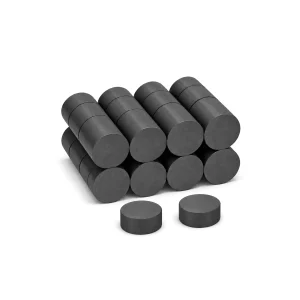
14mm x 8mm Ferrite Disc Magnet Y30 (0.55KG Pull)
From £8.92 (£7.43 ex VAT) -

22mm x 22mm x 5mm Neodymium Block Magnet N40EH – Max Temp 200°C (9.06KG Pull)
From £9.39 (£7.83 ex VAT) -

25mm x 8mm x 2mm Neodymium Block Magnet N52SH – Max Temp 150°C (2.85KG Pull)
From £9.68 (£8.07 ex VAT) -

14mm x 4mm Neodymium Disc Magnet N54H – Max Temp 120° (5.37KG Pull)
From £9.87 (£8.23 ex VAT) -

32mm x 16mm x 3mm Neodymium Block Magnet N52SH – Max Temp 150°C (6.75KG Pull)
From £10.99 (£9.16 ex VAT) -

19mm x 9mm x 3mm Neodymium Block Magnet N50UH – Max Temp 180°C (3.78KG Pull)
From £11.11 (£9.26 ex VAT) -
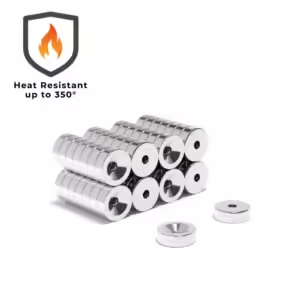
10mm x 5mm x (3.2mm Countersunk Hole) Samarium Cobalt Disc Magnet Sm2Co17 – Max Temp 350°C (0.29KG Pull)
From £11.87 (£9.89 ex VAT) -

20mm x 20mm x 5mm Neodymium Block Magnet N52SH – Max Temp 150°C (10.64KG Pull)
From £12.49 (£10.41 ex VAT) -

10mm x 5mm PTFE Coated Neodymium Disc Magnet N54H – Max Temp 120° (3.81KG Pull)
From £12.82 (£10.68 ex VAT) -

8mm x 12mm Neodymium Cylinder Magnet N48EH – Max Temp 200°C (3.13KG Pull)
From £13.29 (£11.08 ex VAT) -

OR24.5mm x IR21.5mm x T2.5mm Neodymium Arc Magnet N45H – OR North (0.82KG Pull) – Max Temp 120°C
£17.09 (£14.24 ex VAT) -

OR24.5mm x IR21.5mm x T2.5mm Neodymium Arc Magnet N45H – OR South (0.82KG Pull) – Max Temp 120°C
£17.09 (£14.24 ex VAT)
High Temperature Magnet Grades
| Material | Grades in this range | Maximum operating temperature |
|---|---|---|
| Neodymium, M | N50M | 100°C |
| Neodymium, H | N35H, N45H, N54H | 120°C |
| Neodymium, SH | N45SH, N52SH, N54SH | 150°C |
| Neodymium, UH | N45UH, N50UH | 180°C |
| Neodymium, EH | N40EH, N48EH | 200°C |
| Ferrite | Y25, Y30, Y35 | 250°C |
| Samarium cobalt | Sm2Co17 | 350°C |
Full figures for every grade are in our neodymium magnet grades guide, samarium cobalt magnet grades guide and ferrite magnet grades guide.
High Temperature Magnets FAQs
Do magnets lose strength when they get hot?
Yes.
Up to its maximum operating temperature, a magnet loses a little strength while it is hot and gets it back as it cools. Above that temperature some of the loss is permanent, and much hotter still the magnet is demagnetised for good. That is why the grade matters when a magnet runs hot.
To see how heat affects a particular magnet, use our free MagNet calculator: with a free account you can adjust for temperature and check the demagnetisation risk.
How do I choose a magnet grade for high temperatures?
Start with the highest temperature the magnet will reach in use, then choose a grade rated above it from the table above.
Neodymium grades carry letters after the number that show their temperature rating: M, H, SH, UH and EH, in rising order. Our neodymium magnet grades guide gives the maximum operating temperature of every grade.
What do the number and letters in a neodymium grade mean?
The number is the grade’s strength, its maximum energy product in MGOe, so N52 is stronger than N42.
The letters show how well the magnet resists demagnetisation, including from heat. A grade with no letters has the standard rating. Our neodymium magnet grades guide explains both.
When should I use samarium cobalt instead of neodymium?
When your application runs hotter than the neodymium grades allow.
Samarium cobalt is the second strongest permanent magnet material after neodymium, so expect less strength than from a neodymium magnet of the same size. Our samarium cobalt magnet grades guide compares its two types.
Is the maximum temperature a fixed limit?
No. The figure on each product page is the rating for its grade.
How well a particular magnet copes with heat also depends on its shape: a thin magnet magnetised through its thickness is easier to demagnetise than a long one magnetised along its length. The demagnetisation risk in MagNet shows the effect for your magnet. If your application runs close to the limit, tell us the operating conditions and we will advise.
Can't find what you are looking for?
Explore our custom manufacturing service for cost-effective solutions. Get in touch today to see how we can help you.