 info@magnet-store.co.uk
 0800 009 6562


Diametrically Magnetised Disc, Ring and Cylinder Magnets
A diametric magnet has its north and south poles on opposite sides of its curved face, rather than on its flat faces. That generally gives a lower pull force than an axial magnet of the same size, with field lines that loop from one side of the curved face to the other. Turn it on a shaft and its field turns with it, which makes diametric discs the most common magnet used with magnetic sensors. Choose from the stock sizes below. Any other size can be made to order.
Showing all 12 resultsSorted by price: low to high
-
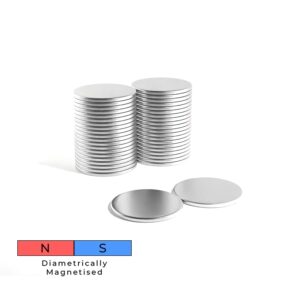
8mm x 1mm Disc Diametrically Magnetised Neodymium N52 (0.17KG Pull)
From £6.64 (£5.53 ex VAT) -

3mm x 12mm Neodymium Cylinder Magnet Diametrically Magnetised N48 (0.12KG Pull)
From £6.83 (£5.69 ex VAT) -
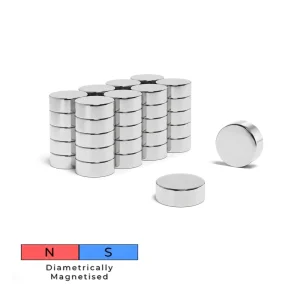
6mm x 2.5mm Cylinder Diametrically Magnetised Neodymium N42 (0.23KG Pull)
From £6.83 (£5.69 ex VAT) -
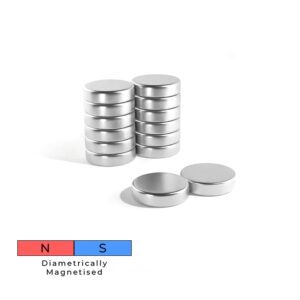
6mm x 3mm Disc Diametrically Magnetised Neodymium N52 (0.33KG Pull)
From £7.02 (£5.85 ex VAT) -
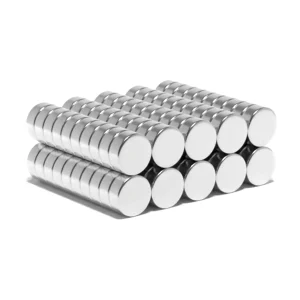
8mm x 3mm Disc Diametrically Magnetised Neodymium N42 (0.41KG Pull)
From £7.21 (£6.01 ex VAT) -

6mm x 4mm Samarium Cobalt Disc Magnet Diametrically Magnetised Sm2Co17 – Max Temp 350°C (0.084KG Pull)
From £7.50 (£6.25 ex VAT) -

6mm x 3mm Neodymium Epoxy Disc Diametrically Magnetised Magnet N42 (0.27KG Pull)
From £7.50 (£6.25 ex VAT) -

5mm x 50mm Cylinder Neodymium Magnet Diametrically Magnetised N52 (0.43KG Pull)
From £7.89 (£6.57 ex VAT) -

8mm x 5mm Disc Diametrically Magnetised Neodymium N42 (0.62KG Pull)
From £8.16 (£6.80 ex VAT) -

8mm x 4mm Disc Diametrically Magnetised Neodymium N42 (0.55KG Pull)
From £8.64 (£7.20 ex VAT) -

6mm x 14mm Neodymium Cylinder Magnet Diametrically Magnetised N48 (0.54KG Pull)
From £9.97 (£8.31 ex VAT) -
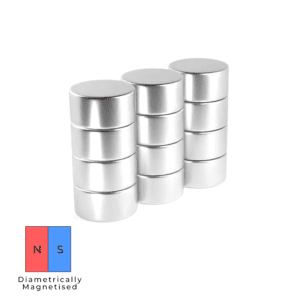
10mm x 10mm Cylinder Diametrically Magnetised Neodymium N52 (1.50KG Pull)
From £14.72 (£12.27 ex VAT)
Diametric Magnets FAQs
What is a diametric magnet?
Most disc, cylinder and ring magnets are magnetised axially, through their thickness, so one flat face is north and the other is south. A diametric magnet is magnetised across its diameter instead, as the name says, so the poles sit on opposite sides of the curved surface. Our magnetisation direction guide explains each direction.
Where are diametric magnets used?
Angle sensors and encoders. A diametric disc sits on the end of a rotating shaft, with the sensor chip facing it across a small air gap. As the shaft turns, the sensor reads the direction of the field and gives the angle. The size and grade needed vary from one application to the next, set by the sensor and the air gap.
Through-shaft sensing. When the end of the shaft isn’t free, a diametric ring goes over the shaft and the sensor sits to one side of it. If you can’t see the ring you need, we can make it to order.
Two-pole motors. A solid diametric cylinder can form the whole rotor of a two-pole motor. Choose a cylinder from the range above. If you can’t see the grade or size you require, get in touch for a custom manufacturing quote.
Magnetic couplings. Diametric magnets on the inner rotor of a magnetic coupling pass torque to the outer rotor without contact, across an air gap and through a wall.
Heat. Each product page lists its maximum temperature. For hotter positions, samarium cobalt and other high-temperature grades are made to order.
How strong are diametric magnets?
Each product title gives that magnet’s pull, which is lower than a standard disc of the same size. In a sensor, what matters is the field at the sensor, because it sets the air gap. MagNet, our free calculator, shows field strength at any distance and has a sensor magnet finder for encoders, Hall-effect sensors and gear-tooth sensors. It also gives the pull for a diametric magnet.
Do you make custom diametric magnets?
Yes. We make diametric discs, cylinders and rings to order in any size, grade or coating, all ISO 9001 certified.
Can't find what you need?
If you can't find what you're looking for, please get in touch and a member of our team will be happy to help.