 info@magnet-store.co.uk
  0800 009 6562
Grades of Alnico Magnets
Learn all available Alnico grades and properties.
Alnico Magnet Grades
Alnico (Al-Ni-Co) magnets are powerful permanent magnets made from an alloy of aluminium, nickel and cobalt. One of the key benefits of alnico magnets is the ability to perform in extremely hot temperatures.
Not only can alnico magnets retain their magnetism in hot temperatures, but the alloy has low temperature coefficient which means the physical change during these extreme conditions is minimal. Alnico magnets have less magnetism than neodymium and samarium cobalt magnets, but they are still more powerful than ceramic or ferrite magnets.
Alnico magnets were first developed in the 1930s and widely used in military equipment during world war II. The use of alnico magnets rapidly spread after the war and was often used in machinery. Alnico magnets are produced by either sintering or casting and casted alnico magnets are the most commonly produced alnico magnets.
Sintered Alnico vs Cast Alnico
Alnico magnets come in isotropic alnico magnets and anisotropic alnico magnets. The difference between these two is isotropic Alnico magnets can be magnetised in any chosen direction, whereas anisotropic has one fixed magnetisation direction.
Sintered Alnico
Sintered alnico magnets generally have less magnetism than cast alnico magnets (MGOe between 4.45-5.5) but they can be manufactured into smaller, more intricate parts. Sintered Alnico magnets are typically lower cost than cast alnico so they’re ideal for projects that have strict budgets.
Sintered alnico magnets are excellent at operating in high temperatures (up to 450°C / 840°F).
Cast Alnico
Cast alnico magnets are manufactured by pouring the molten alloy into a mold and further putting it through several heat treating processes. Cast alnico magnets produced a stronger magnetic field than sintered alnico magnets (MGOe between 2.0 to 9.0) but they do generally cost more.
The maximum operating temperature of cast magnets are also higher – capable of withstanding temperatures up to 525°C to 977 °F.
The Most Popular Alnico Grades
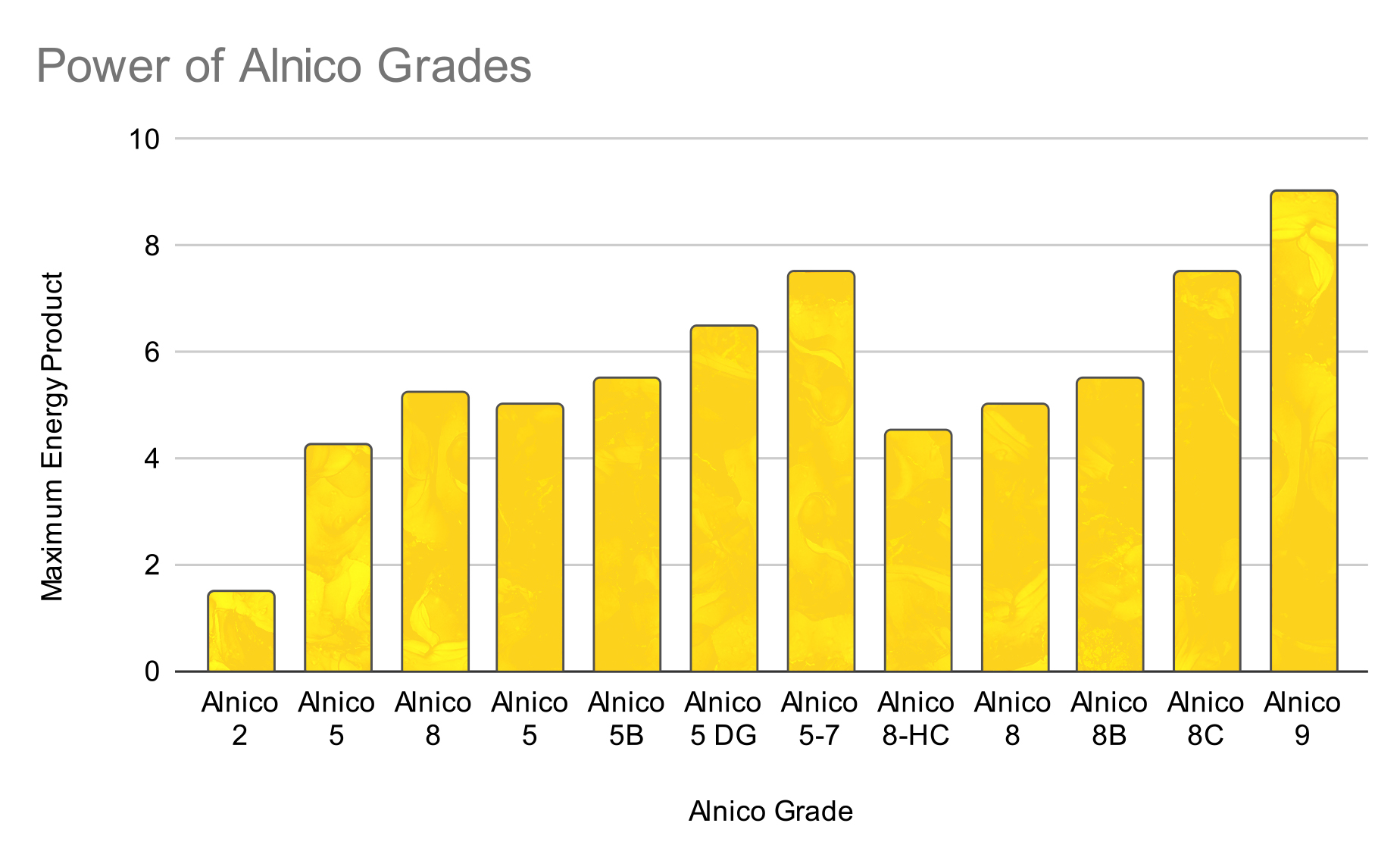
Alnico magnets can start as low as anisotropic sintered alnico 3 (MGOe 2.9) and go as high as anisotropic cast alnico 9(MGOe 9.0). Cast and sintered alnico magnets are fantastic magnets, but for applications that require the most magnetic power (MGOe), cast magnets are recommended.
The most commonly used alnico magnet is Alnico 5 and Alnico 8. It is worth noting that there are 4 variations of cast Alnico 5 which all have different qualities. Therefore, always make sure you’re referring to the correct Alnico 5 on request.
Isotropic Cast Alnico
Alnico 1
Alnico 2
Alnico 3
Anisotropic Cast Alnico
Alnico 5
Alnico 5DG
Alnico 5-7
Alnico 6
Alnico 8
Alnico 8HC
Alnico 9
Anisotropic Sintered Alnico
Alnico 5
Alnico 6
Alnico 8
Alnico 8HC
Isotropic Sintered Alnico
Alnico 2
| Alnico Grade | Remanence (Br) | Coercive Force (Hc) | Intrinsic Coercive Force (Hci) | Maximum Energy Product (BH)max | Max Temp | ||||
|---|---|---|---|---|---|---|---|---|---|
| kG | T | Oe | kA/m | Oe | kA/m | MGOe | kJ/m3 | ||
| Cast Alnico Grades - Typical Reference Ranges | |||||||||
| Cast Alnico 2 | 6.8 - 7.3 | 0.68 - 0.73 | 550 - 600 | 44 - 48 | 570 - 620 | 45 - 49 | 1.5 - 1.7 | 12 - 14 | 450°C |
| Cast Alnico 3 | 6.0 - 6.45 | 0.60 - 0.65 | 500 - 550 | 40 - 44 | 520 - 570 | 41 - 45 | 1.2 - 1.5 | 10 - 12 | 450 - 500°C |
| Cast Alnico 5 | 11.0 - 12.9 | 1.10 - 1.29 | 600 - 660 | 48 - 53 | 620 - 680 | 49 - 54 | 4.25 - 5.5 | 34 - 44 | 500 - 525°C |
| Cast Alnico 5DG | 12.8 - 13.7 | 1.28 - 1.37 | 680 - 730 | 54 - 58 | 690 - 740 | 55 - 59 | 6.0 - 6.6 | 48 - 52 | 525°C |
| Cast Alnico 5-7 | 13.0 - 13.9 | 1.30 - 1.39 | 700 - 750 | 56 - 60 | 720 - 750 | 57 - 60 | 6.5 - 7.5 | 52 - 60 | 525°C |
| Cast Alnico 8 | 7.9 - 9.0 | 0.79 - 0.90 | 1,380 - 1,550 | 110 - 123 | 1,440 - 1,650 | 115 - 131 | 4.75 - 7.5 | 38 - 60 | 525 - 550°C |
| Cast Alnico 8HC | 7.0 - 7.2 | 0.70 - 0.72 | 1,750 - 1,880 | 139 - 150 | 1,750 - 1,900 | 139 - 152 | 4.5 | 36 | 525 - 550°C |
| Cast Alnico 9 | 10.0 - 10.8 | 1.00 - 1.08 | 1,380 - 1,500 | 110 - 120 | 1,400 - 1,530 | 112 - 122 | 7.5 - 10.0 | 60 - 80 | 550°C |
| Sintered Alnico Grades - Typical Reference Ranges | |||||||||
| Sintered Alnico 2 | 6.8 - 7.3 | 0.68 - 0.73 | 550 - 600 | 44 - 48 | 570 - 620 | 45 - 49 | 1.5 - 1.7 | 12 - 14 | 450°C |
| Sintered Alnico 5 | 11.8 - 12.6 | 1.18 - 1.26 | 600 - 650 | 48 - 52 | 610 - 660 | 49 - 53 | 4.2 - 4.5 | 33 - 36 | 450 - 525°C |
| Sintered Alnico 6 | 9.0 - 9.7 | 0.90 - 0.97 | 680 - 730 | 54 - 58 | 690 - 740 | 55 - 59 | 3.4 - 3.8 | 27 - 30 | 525°C |
| Sintered Alnico 8 | 7.8 - 8.5 | 0.78 - 0.85 | 1,430 - 1,530 | 114 - 122 | 1,480 - 1,580 | 118 - 126 | 4.6 - 5.5 | 37 - 44 | 450 - 550°C |
What Is The Strongest Alnico Grade?
The strongest grade of Alnico magnet is anisotropic cast alnico 9 which have a Br (KG) of 9.0. The disadvantage of this grade is they cost more than any other grade so they’re only used where power is more important than price.
What Can You Customise?

Types of
Magnets

Size and Shape Magnets

Magnetic
Grades

Magnetisation Direction
Magnetic Coatings