 info@magnet-store.co.uk
 0800 009 6562


How the poles are laid out
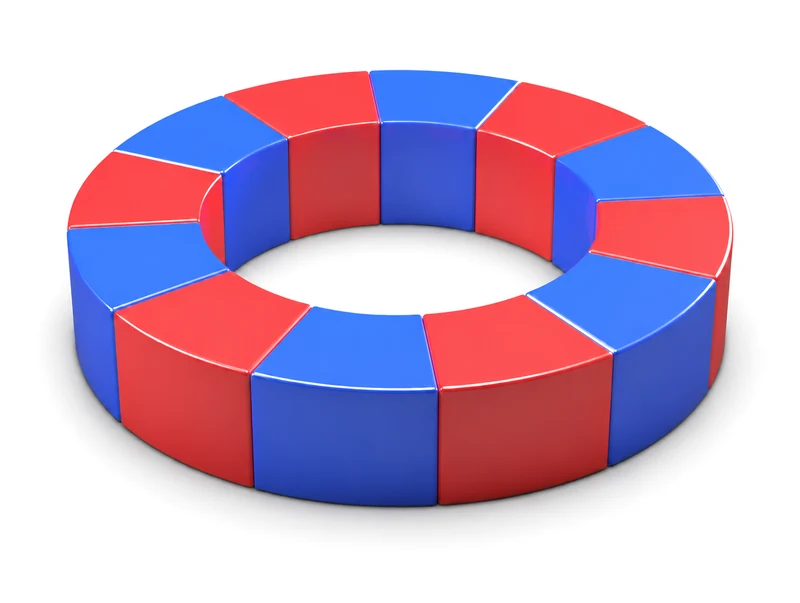
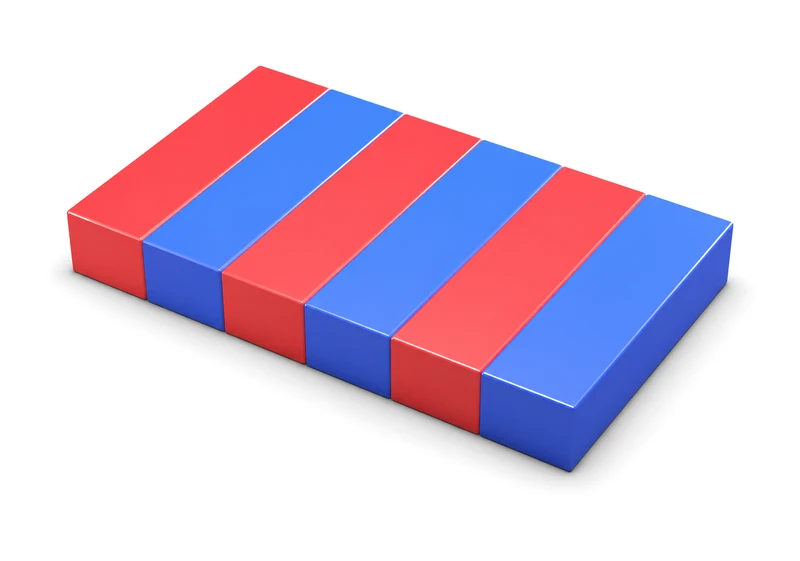
A standard magnet has one north face and one south face. A multi-pole magnet splits a surface into alternating zones: north, south, north, south. The zones can sit across a flat face, as sectors on a disc or strips on a block, or around the outside of a ring. North is shown in red and south in blue.
For a ring with one north and one south pole, see diametric ring magnets.
Disc, poles on one face
Sectors alternate N and S

Ring, poles around the edge
Often used in motors and encoders
Block, poles in strips
Strip width = pole pitch
Where they’re used
-
Encoders and position sensors: a sensor reads the poles as they pass, so the pattern tells it the position.
-
Small motors and stepper rotors: the poles alternate around the rotor.
-
Magnetic couplings: pole patterns on two parts pass torque across a gap without contact.
Which material
Sintered neodymium is set with one preferred magnetisation direction when it’s made. Bonded neodymium can be magnetised in whichever direction or pole pattern the job needs, trading some strength for that freedom. We’ll advise which suits your design.
What to send us
Complex pole patterns may carry a configuration fee, shown on your quote.
- A drawing or CAD file, with dimensions and tolerances
- The number of poles and the pole pitch
- Which surface carries the poles: a flat face or the outside of a ring
- Material and grade, coating and working temperature
- Quantity
Questions
Do you keep multi-pole magnets in stock?
No. Each one is made to order, to your drawing and pole pattern.
What is pole pitch?
Pole pitch is the distance from the centre of one pole to the centre of the next, which is the width of one pole. One north pole and one south pole make a pole pair, so the pattern repeats every two pole pitches. Show the pole pitch and the number of poles on your drawing.